


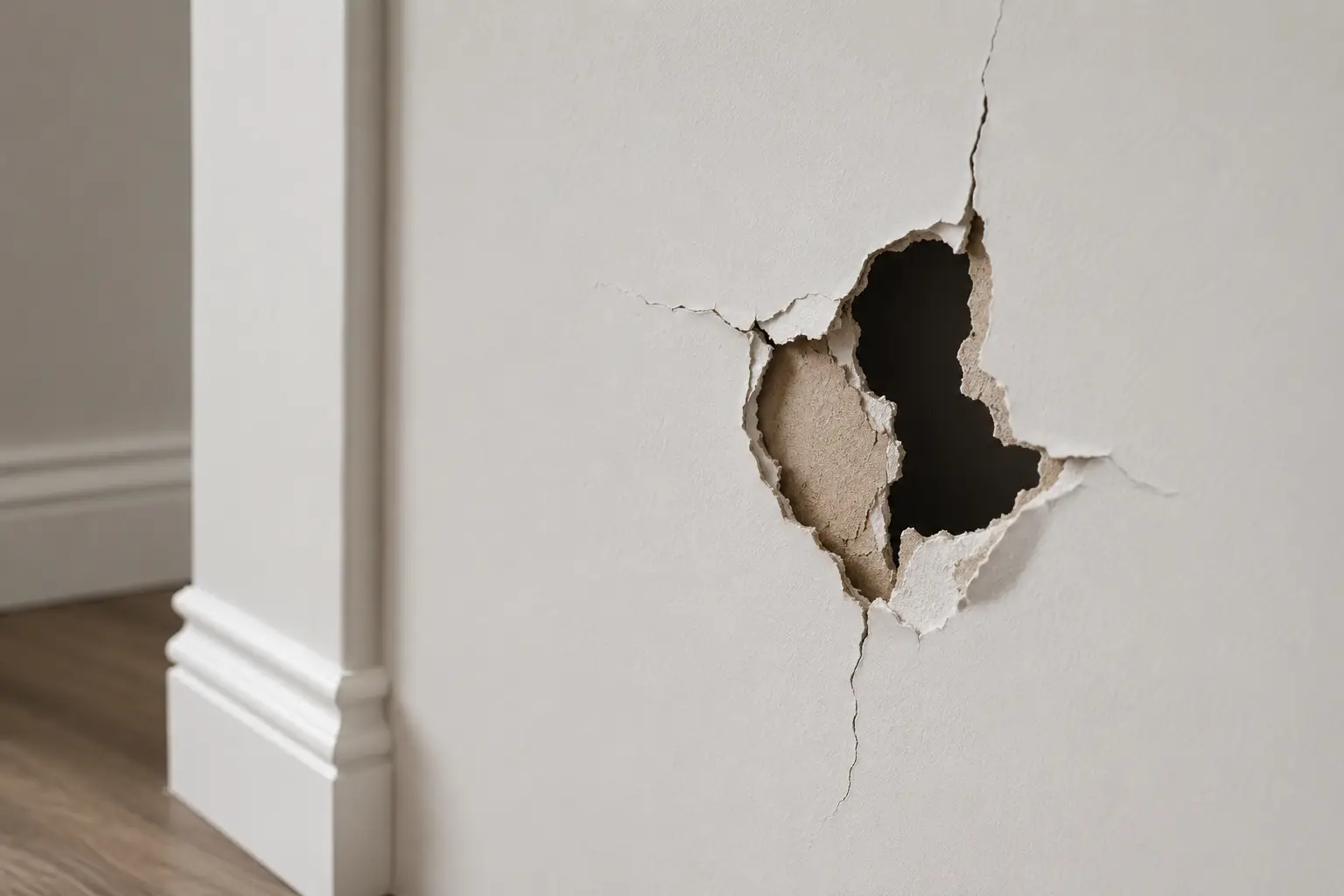
How to Tell When Drywall Damage Needs More Than a Quick Patch
Not every hole in a wall requires a major repair. But knowing when a simple patch isn’t enough can save you time, money, and another repair down the road.
After more than 60 combined years working with drywall, we’ve learned that one of the most important parts of any repair happens before the first piece of drywall is cut: understanding what you’re actually looking at.
A damaged wall doesn’t always tell the whole story from the surface.
Sometimes it’s a small dent. Sometimes it’s a hole that can be patched in an afternoon. And sometimes what looks like a minor problem is the visible part of something larger.
Small Damage Is Usually Exactly That
Every homeowner eventually ends up with a few holes, dents, or dings in the wall.
A door handle hits the wall. Furniture gets moved. A picture comes down. Someone accidentally puts a little more enthusiasm into a DIY project than the drywall was prepared to handle.
Small, isolated damage can often be repaired without replacing a large section of drywall.
The important thing is making sure the surrounding material is still solid and that there isn’t another problem causing the damage.
A proper repair isn’t simply a matter of filling a hole with compound and calling it finished. The damaged material needs to be addressed, the repair needs to be properly supported when necessary, and the surface needs to be finished so it blends with the surrounding wall.
That’s where experience matters.
When a “Small Repair” Isn’t Really Small
There are certain warning signs that tell us to look beyond the immediate damage.
Water damage
Water-damaged drywall deserves particular attention.
If drywall has become soft, swollen, stained, crumbly, or otherwise compromised by moisture, covering the visible damage isn’t necessarily a solution.
The source of the moisture needs to be addressed, and damaged material may need to be removed and replaced.
Otherwise, you’re potentially putting a fresh repair over a problem that is still there.
Large holes or damaged sections
A larger hole may require more than simply filling the opening.
The damaged area may need to be cut back to sound material, properly supported, and replaced with a piece of drywall that fits correctly.
The repair then needs to be taped, finished, sanded, and blended into the surrounding wall.
The larger the repair, the more important those transitions become.
Cracks that keep coming back
A crack that repeatedly returns deserves attention.
Some cracks are cosmetic. Others can be related to movement, settling, joints, framing, moisture, or other conditions affecting the wall.
Simply filling the same crack over and over may make it look better temporarily, but it doesn’t necessarily address why the crack keeps appearing.
Soft, sagging, or crumbling drywall
This is another situation where a quick cosmetic patch may not be the right answer.
Drywall should have a solid, finished feel. If an area is soft, sagging, separating, or crumbling, it may have been compromised by moisture, impact, age, or another underlying issue.
That’s when an experienced eye can make a difference.
The Hard Part Is Making the Repair Disappear
Replacing damaged drywall is only part of the job.
The real test comes during finishing.
A repair can be structurally sound and still look terrible if the seam is visible, the compound isn’t feathered properly, or the texture doesn’t match the surrounding wall.
We’ve spent decades learning that the difference between a repair that looks “fixed” and one that looks like it was never damaged in the first place is often in the finishing work.
Lighting can expose imperfections that aren’t obvious while you’re standing directly in front of the wall. Paint can make ridges and uneven transitions suddenly stand out. Texture differences can make a repair visible from across the room.
That’s why proper preparation and finishing matter.
When Should You Bring in a Professional?
It’s worth having an experienced drywall professional look at the problem when:
- The damaged area is large.
- The drywall is soft, swollen, sagging, or crumbling.
- There are signs of water damage.
- A crack keeps returning.
- Multiple areas are damaged.
- The drywall has pulled away from the framing.
- You aren’t sure how extensive the damage is.
- You want the finished repair to blend into the existing wall.
Sometimes the right answer really is a simple patch.
That’s good news.
The point of having an experienced professional look at it isn’t to turn every small repair into a major project. It’s to know when a small repair is actually a small repair.
Experience Shows in the Finished Wall
Drywall work is one of those trades where experience teaches you things that don’t always show up in a textbook.
You learn how material behaves. You learn how much compound to use, how far to feather a joint, how lighting affects a finished surface, and when a wall needs more preparation before the finishing work begins.
After more than 60 combined years in the drywall business, we’ve learned to pay attention to those details.
Because when the tools are put away and the wall is painted, what matters is what the homeowner sees.
At Howard Drywall, we bring decades of hands-on experience to drywall repair, installation, and finishing. If your wall needs attention, contact us to discuss the project and determine the right approach.